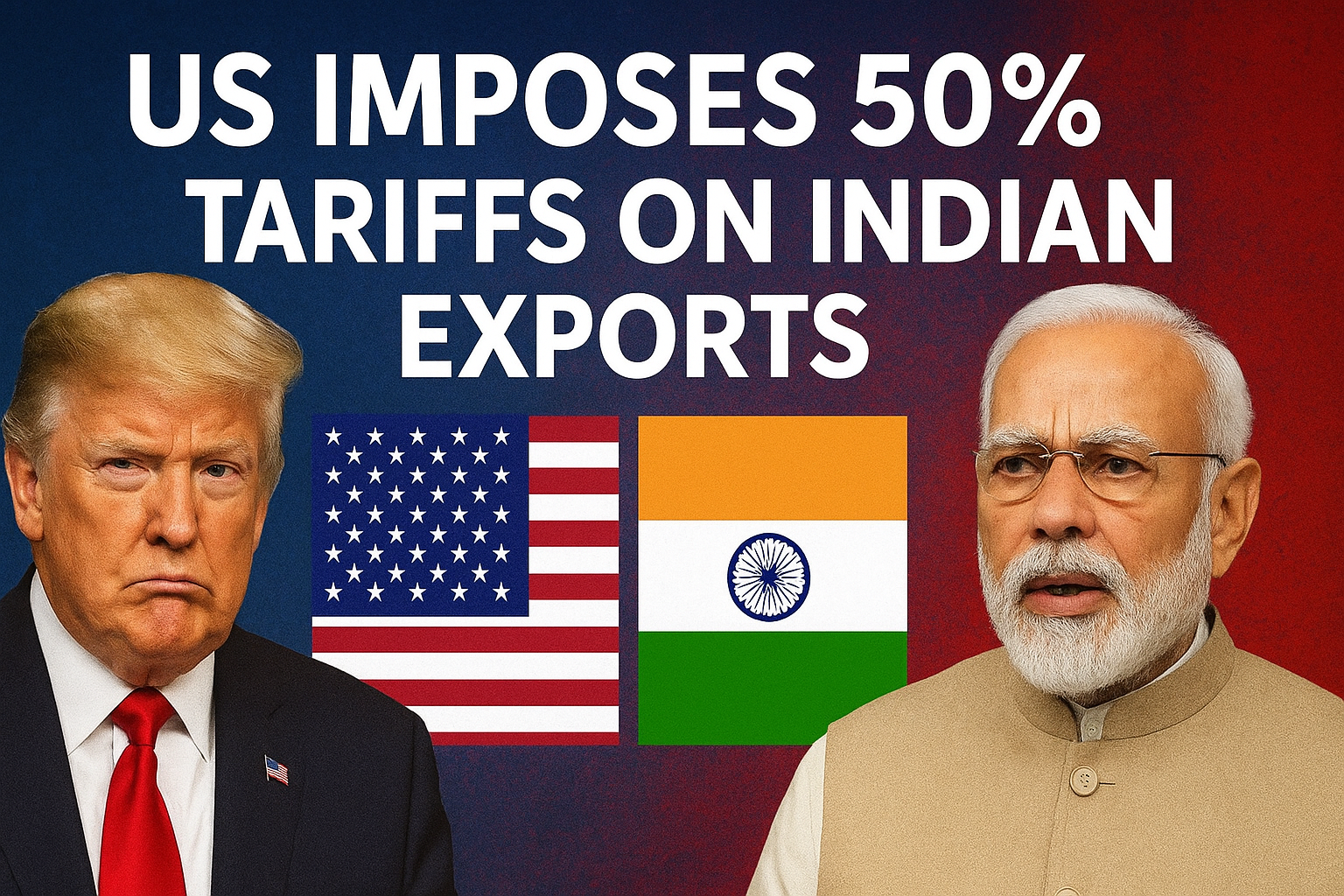
US Imposes 50% Tariffs on Indian Exports: A Costly Gamble for Washington
Author: Manish Sharma
Introduction
Rojgar Babu News Desk: In August 2025, the United States escalated its trade conflict with India by imposing a 50% tariff on a wide range of Indian exports. The move, largely triggered by India’s continued import of discounted Russian crude oil, has disrupted one of the fastest-growing bilateral trade partnerships in the world.
US imposes 50% tariffs on Indian exports. While this step is expected to dent India’s export earnings in key sectors such as textiles, gems and jewelry, seafood, and auto components, analysts point out that the United States itself may end up paying a steeper price. The new duties risk raising inflation, disrupting supply chains, reducing consumer welfare, and undermining the strategic partnership that both nations have carefully built over the past decade.
Why Did the U.S. Impose 50% Tariffs?
- The White House argues that India’s energy imports from Russia undercut U.S. sanctions and foreign policy objectives.
- Initially, a 25% tariff was announced, which was later doubled to 50%, effective August 27, 2025.
- Around 55% of India’s $87 billion exports to the U.S. now fall under the high-tariff regime.
India’s Exposure to the Tariffs
Before analyzing the U.S. fallout, let’s briefly outline the pressure on India:
- Estimated annual export loss: $25–55 billion.
- GDP impact: 0.2 to 1 percentage point slowdown.
- Key sectors hit: gems & jewelry ($10B), textiles ($3B+), seafood ($2.6B), auto parts ($6.6B).
- Millions of jobs in labor-intensive industries are at risk.
America’s Losses from the Tariff Escalation
1. Inflationary Pressure
According to an SBI Research report, the tariffs could shave 40–50 basis points off U.S. GDP while fueling inflation.
- Indian exports are often low-cost essentials (garments, household items, auto parts).
- A product previously sold at $100 may now retail for $150 or more.
- Inflation will particularly impact low- and middle-income American households, who rely on affordable imports.
2. Supply Chain Disruptions
The U.S. depends heavily on India for:
- Textiles & apparel (a major input for retailers like Walmart, Target, and Macy’s).
- Jewelry & gemstones, which form a significant part of luxury retail.
- Auto components, where Indian suppliers fill critical gaps in the automotive industry.
Finding alternate sources is not straightforward:
- Vietnam and Bangladesh can supply textiles, but their scale is limited.
- African nations are emerging in gems, but logistics and quality issues remain.
- Relocating supply chains would raise costs for U.S. companies.
3. Rising Costs for U.S. Consumers
American shoppers are likely to bear the brunt:
- Clothing, jewelry, and furniture prices are expected to jump by double digits.
- Shrimp imports, a staple in U.S. seafood consumption, may see retail price surges of 20–30%.
- With consumer spending already slowing, higher prices may reduce demand, hurting U.S. retailers.
4. Job Losses in the U.S.
- Thousands of U.S. small businesses rely on Indian imports for retail margins.
- Importers, wholesalers, and retailers now face squeezed profitability.
- Industries tied to Indian raw materials (e.g., diamond polishing, apparel finishing) risk layoffs and closures.
5. Strategic and Diplomatic Costs
- India is seen as a key partner in countering China in the Indo-Pacific.
- The tariff war risks alienating New Delhi, just as Washington seeks stronger cooperation through platforms like the Quad.
- India is already looking to diversify trade toward Europe, Latin America, and the Middle East, which could reduce U.S. market relevance in the long term.
India’s Response to Cushion the Blow
The Indian government has announced measures to support its exporters:
- ₹12,000 crore ($1.4B) in income-tax cuts and GST reforms to boost domestic demand.
- Financial assistance for exporters through subsidies, low-interest credit, and insurance schemes.
- Aggressive search for new markets in Europe, Africa, and Latin America.
- Continued diplomatic engagement with Washington to avoid further escalation.
- Experts say the US 50% tariffs on Indian exports may also backfireExperts say the US 50% tariffs on Indian exports may also backfire
Comparative Impact: Who Loses More?
| Metric | India’s Loss | U.S. Loss |
|---|---|---|
| Export earnings | $25–55B annually | Import costs rising by billions |
| Jobs | Millions at risk in textiles/jewelry | Thousands at risk in retail & logistics |
| GDP impact | –0.2% to –1% | –0.4% to –0.5% |
| Inflation | Manageable domestically due to GST cuts | Sharp rise in consumer prices |
| Strategic fallout | Diversification opportunity | Erosion of Indo-U.S. trust |
Outlook: A Lose-Lose Situation
While the tariffs were designed to punish India, the reality is a lose-lose outcome:
- India faces export and job losses, but can pivot to alternative markets.
- The U.S. faces inflation, supply chain disruptions, consumer backlash, and diplomatic damage.
The long-term cost may be strategic: pushing India closer to alternative partners and weakening U.S. influence in Asia.
Conclusion
The U.S. decision to impose 50% tariffs on Indian exports is more than a trade dispute—it is a policy miscalculation with global implications.
India will take an economic hit, but it has tools to adapt. The U.S., however, risks hurting its own economy, consumers, and strategic interests. As history shows, tariff wars rarely produce winners—and in this case, Washington may end up paying the higher price.
👉 “According to a recent report by Reuters, the tariff decision could reshape global trade flows.”
👉 “Economic experts quoted in the Economic Times suggest that the US may also face heavy losses.”
Thank you for reading! Stay tuned with Rojgar Babu for more updates on global trade and India’s economy.
For more latest updates on government exams and results, visit our Rojgar Babu News Section
It’s a big mistake by trump
rihgt bro
Checked out xjwinbr the other day and it was pretty decent. Nothing super fancy, but it got the job done. Might be worth a look if you’re bored! Give xjwinbr a shot.
VK777. Decent site. I like the variety of games they got going. Solid choice to kill some time if you need. Go see vk777 to waste an afternoon.